
Blog Post
AI In Healthcare
POSTED BY ASMGi ON FEBRUARY 24, 2023
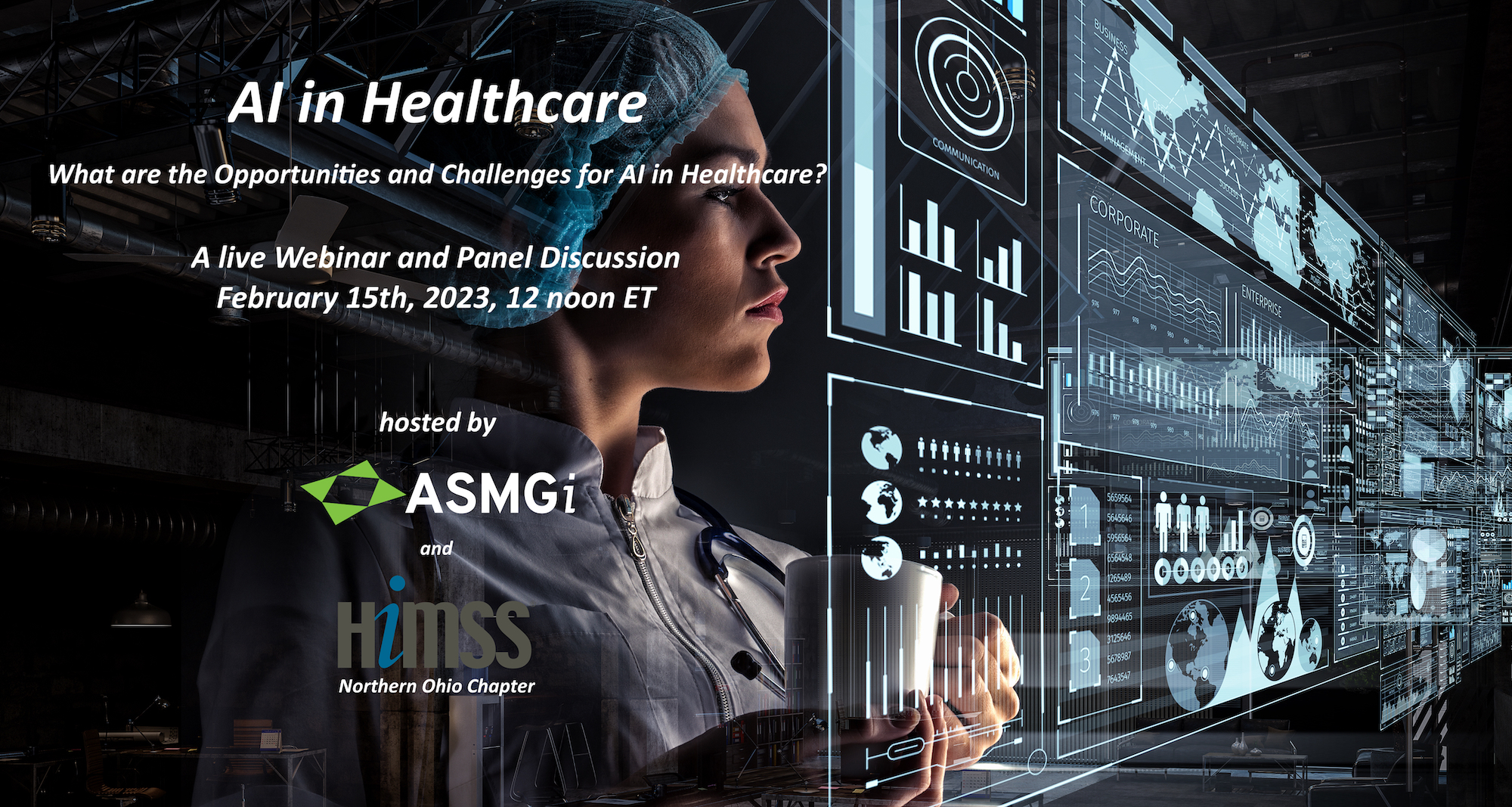
ASMGi recently held a webinar on Opportunities for AI in Healthcare. It was well received by our audience and you can view the webinar here. https://asmgi.com/videos/
Each of our panelists also provided some additional thoughts on this important and timely topic.
Piyush Mathur MD, FCCM, FACA, Cleveland Clinic
Over the last decade, we have seen an explosive growth in research and development of AI solutions for healthcare application. This unparalleled growth has also seen translation and implementation of these solutions at bedside. Most of these FDA approved applications are based on image analysis such as interpretation of Chest X-rays, ejection fraction estimation on Echocardiography, diabetic retinopathy screening or colonoscopy for cancer detection.
It is an exciting time, as with newer developments in the field of natural language processing, Transformers, large language models(GPT), we are starting to see solutions being developed using text data which represents a key part of information in healthcare.
At the same time there are growing concerns around bias, privacy and security of data and AI models. With healthcare industry facing increasing number of cybersecurity attacks, vulnerability of these digital solutions in healthcare is a real and present danger. Industry experts, healthcare systems and regulators are focused on understanding these threats and developing solutions to mitigate them. We need to partner together to protect our patients and ensure security of their data.
Ivo Driesser, Siemens Healthineers
Artificial intelligence in healthcare: Transforming data into knowledge for better care
Leveraging AI for the future of healthcare poses challenges. The Siemens Healthineers Al-powered solutions address major challenges that are facing the healthcare field.
Right now, the demand for diagnostic services is outpacing the supply of experts in the workforce. Developing solutions for managing this ever increasing workload is a crucial task for the healthcare sector. A big topic is “Work-Life balance” too. Moreover, as the workload is growing, diagnostics and treatment are also becoming more complex. Diagnostic experts and physicians need a new set of tools that can handle large volumes of medical data quickly and accurately, allowing you to make more objective treatment decisions based on quantitative data and tailored to the needs of the individual patient. To provide this new toolset, Siemens Healthineers will need to draw on the power of artificial intelligence.
AI is a key technology for digitalizing healthcare and enables healthcare providers to transform care delivery, expand precision medicine and improve the patient experience. Siemens Healthineers has developed a portfolio of more than 75 AI-powered solutions that help to automate and standardize not only workflows but also complex diagnostics to meet the needs of the individual patient.
With the help of AI, institutions are able to set a consistent care-standard as AI enabled outcomes have an impact on inter-read variability for example.
Suman Mishra – GAVS Technologies
Healthcare is at a crucial juncture where the impact and usage of AI cannot be ignored anymore. The pandemic has caused an irreversible process due to which the Digital transformation has accelerated by leaps and bounds. The transition from “Use Digital” to “Be Digital” has already begun. As consumerism in Healthcare develops and AI takes the center stage, the demand to change the way care is delivered is growing pretty strong. Patients a.k.a. Consumers are now demanding the healthcare systems to know who they are when they call, get guidance to the nearest and most familiar hospitals they visit often, and in essence asking for care to be highly personalized. This creates an opportunity for AI to help health systems to be more predictive and insightful in nature. As Payviders try to save cost, AI can help in preventive care, intelligent automation, patient engagement, reduce provider burnout by introducing intelligent automation, assistive and augmentative intelligence to predict readmission, disease prognosis etc.
The challenges I see is mostly on the adoption of newer technology. The lack of trust on AI based technology solutions is truly prevalent in Healthcare organizations. At the end of the day, it’s the complete and accurate data that leads to accurate AI predictions. Most of the time the focus is not on data standardization rather it’s on how quickly AI can produce results. With that said, I think these are very exciting times and the next 30 years will be revolutionary in how AI evolves and helps mankind take care of themselves and each other!